.svg)
.svg)


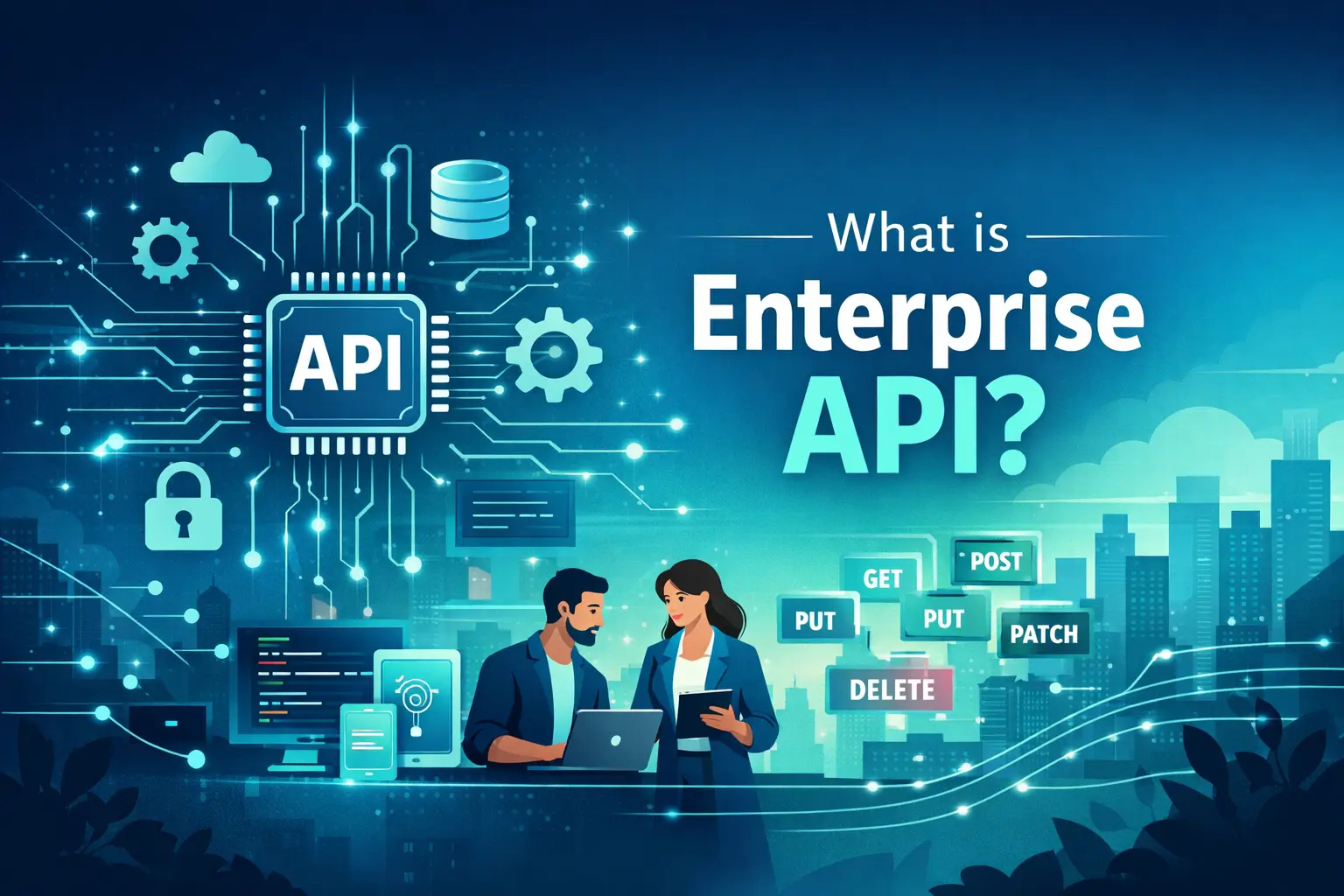

Organizations today rely on many systems to run their operations. Customer platforms, finance tools, internal applications, analytics platforms, and legacy infrastructure all generate and use data. The challenge is ensuring these systems can communicate with each other efficiently.
When designed correctly, enterprise APIs support integration, automation, and scalable system architecture across the organization. This article explains what enterprise APIs are, how they work, and how businesses can build an effective enterprise API strategy.
What Is an Enterprise API?
An enterprise API is an application programming interface used to connect enterprise systems, applications, and services.
Instead of accessing a database directly or integrating systems through custom connections, applications interact through APIs that expose specific functionality.
For example, an organization might expose an Address Validation API that allows different applications to retrieve delivery addresses, delivery updates, or validate the addresses. Each system can access the same service without needing to understand how the data is stored or processed internally.
Enterprise APIs are commonly used for:
- Connecting internal business applications
- Integrating SaaS platforms with internal systems
- Sharing services with partners
- Enabling communication between microservices
This approach makes enterprise systems easier to manage and extend.
4 Key Capabilities of Enterprise APIs
Enterprise APIs must support several important capabilities to be effective within large organizations.
1. Reusable Services
APIs allow organizations to reuse existing functionality across multiple applications.
Instead of rebuilding the same capabilities repeatedly, teams can consume existing services through APIs.
Common reusable services include:
- authentication services
- payment processing
- customer data services
- notification services
This reuse reduces development effort and allows teams to focus on building new features rather than duplicating existing functionality.
2. Single Source of Truth for Data
Enterprise APIs help maintain consistent data across applications.
When each system maintains its own copy of the same dataset, inconsistencies often occur. APIs allow organizations to centralize critical data services and expose them to other systems.
This ensures that updates occur in a single location and that all applications access the same information.
3. Integration Across Systems
Enterprise environments often contain a mix of legacy infrastructure and modern cloud platforms.
APIs provide a way to integrate these systems without replacing them entirely.
For example:
- legacy databases can expose data through APIs
- on-premise systems can communicate with cloud services
- SaaS applications can synchronize data with internal platforms
This integration capability allows organizations to modernize their technology stack gradually.
4. Governance and Control
As organizations create more APIs, governance becomes necessary. Without governance, teams may create overlapping APIs, inconsistent designs, or security vulnerabilities.
Enterprise API governance ensures:
- consistent API design standards
- proper versioning practices
- security and compliance controls
- documentation requirements
Governance frameworks help organizations manage APIs across their entire lifecycle.
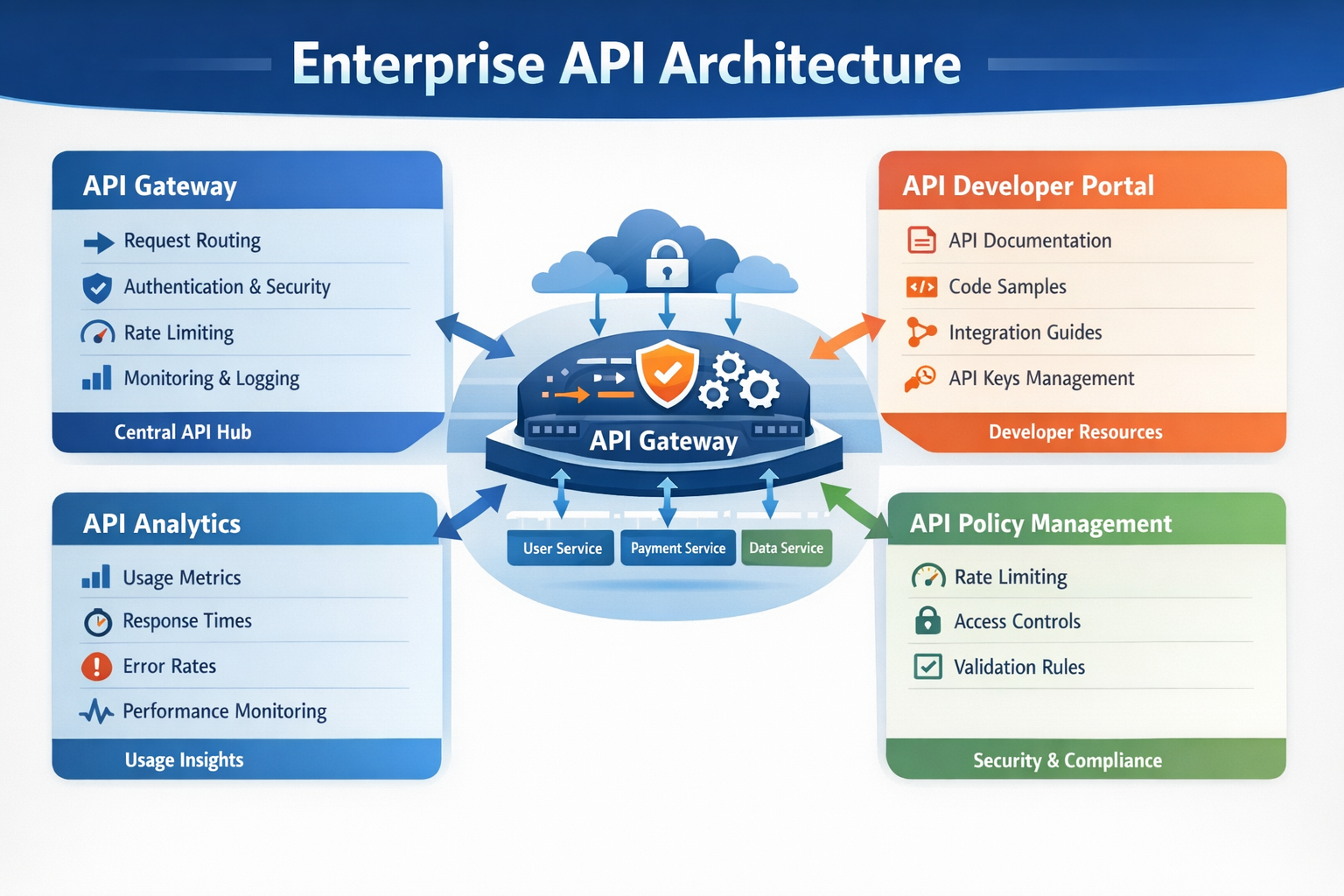
Enterprise API Architecture
A typical enterprise API environment includes several supporting components that manage API traffic and usage.
Types of APIs Used in Enterprises
Organizations use several types of APIs depending on their integration needs.
Why Enterprise APIs Matter for Modern Businesses
Enterprise APIs play an important role in modern software architecture. They allow organizations to build connected systems without tightly coupling applications together.
Enable System Integration
Most organizations operate dozens or even hundreds of software systems. These systems often store related data but do not communicate easily.
Enterprise APIs allow systems such as CRM platforms, ERP tools, HR systems, and analytics platforms to exchange information through standardized interfaces.
Instead of building custom integrations every time a new system is introduced, developers can simply consume an existing API.
This reduces integration complexity and improves system interoperability.
Break Big Apps into Smaller Pieces
APIs help you split a large application into smaller, separate parts that each handle one job. These parts talk to each other through APIs.
For example, an online store might have separate parts for orders, payments, and shipping each running on its own but staying connected through APIs. This makes it easier to update one part without breaking the others, and helps your app grow over time.
Improve Data Accessibility
APIs provide structured access to enterprise data. Teams across the organization can retrieve data from centralized services instead of building their own copies of datasets.
For example:
- Marketing dashboards may access campaign data through an analytics API
- Finance systems may retrieve billing data through a payment API
- Customer support tools may access account information through a customer API
This approach improves data transparency and reduces duplication.
Support Partner Ecosystems
Enterprise APIs also allow organizations to expose services to external partners.
For example, a logistics company may offer shipping APIs that partners can integrate into their applications. Payment providers often offer APIs that allow businesses to process transactions within their platforms.
These integrations allow organizations to expand their digital ecosystems while maintaining control over how services are accessed.
Enterprise API Lifecycle
Enterprise APIs follow a lifecycle similar to other software products.
API Design
The design stage defines how the API will work. Teams decide on endpoints, request and response formats, authentication methods, and naming conventions to ensure the API is structured consistently and easy for developers to use.
API Development
In this stage, developers build the API using programming languages such as Java, Python, C#, or Node.js. The implementation includes creating business logic, validation checks, error handling, and connecting the API to backend systems.
API Testing
Before release, APIs are tested to confirm they work reliably and securely. This includes functional testing, performance testing, security checks, and validating how the API handles errors or unexpected inputs.
API Deployment
Once testing is complete, the API is released to production through an API gateway or management platform. Deployment can occur in cloud environments, internal infrastructure, or hybrid systems depending on the organization’s architecture.
API Deprecation
Over time, older API versions are phased out and replaced with updated ones. Teams manage this transition by maintaining backward compatibility where possible, setting migration timelines, and clearly communicating changes to developers.
Common Challenges in Enterprise API Management
Despite their advantages, enterprise APIs introduce several management challenges.
API Sprawl
API sprawl is a common issue. As different teams build services independently, organizations can quickly accumulate hundreds of APIs. Without a centralized view, it becomes difficult to understand which APIs exist, who owns them, and how they are being used. Maintaining a well-managed API catalog helps teams discover, track, and govern APIs more effectively.
Version Management
When APIs change, dependent applications may break if those changes are not handled carefully. Implementing clear versioning practices allows organizations to introduce updates while preserving compatibility for existing integrations.
Documentation Quality
Finally, documentation quality plays a major role in API adoption. Developers depend on clear documentation to understand how to integrate and use APIs. When documentation is incomplete or outdated, integration becomes slower and support requests increase. Well-structured documentation, along with examples and tutorials, makes APIs easier to adopt and maintain.
Easyship’s Enterprise API Automates Shipping for Your Business
Enterprise APIs help organizations connect systems, automate workflows, and scale integrations across their technology ecosystem.
Easyship helps connect eCommerce stores, carriers, marketplaces, and warehouse systems. This allows merchants to manage shipping, rates, and tracking across multiple platforms in one place. By building a strong API strategy, companies can simplify integrations, improve operational efficiency, and support a growing partner ecosystem.
Enterprise API FAQs
1. What is an enterprise API?
An enterprise API is an application programming interface designed for use within or across large organizations, enabling different systems, services, or applications to securely communicate and share data at scale.
2. What does API mean?
API stands for Application Programming Interface—a set of rules that allows software applications to communicate with each other.
3. What are the 5 API methods?
The five common HTTP API methods are:
- GET – Retrieve data
- POST – Create new data
- PUT – Update existing data (replace)
- PATCH – Partially update data
- DELETE – Remove data


.svg)







.svg)
.svg)
.svg)

.svg)
.svg)