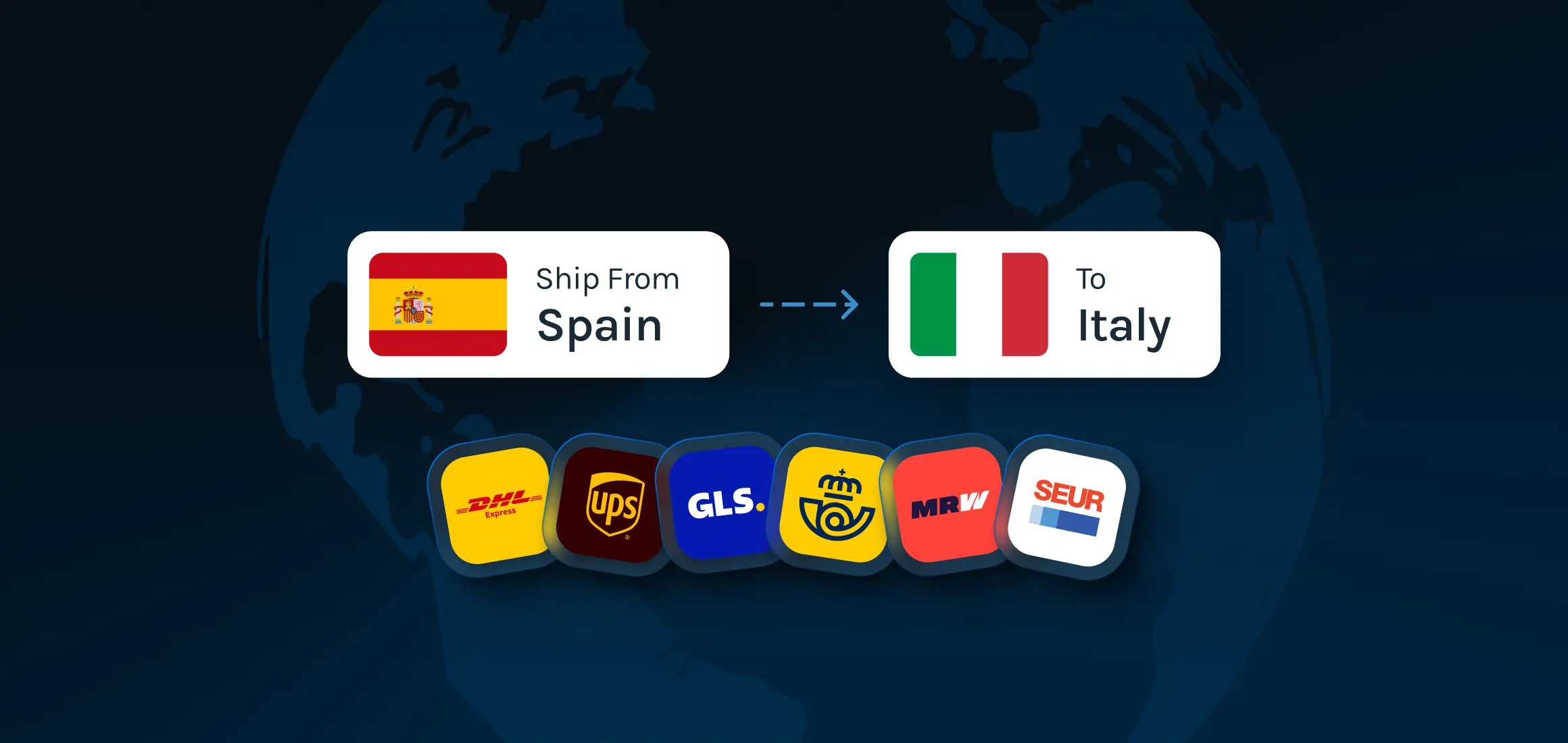
Sending a parcel from Spain to Italy costs around €12 to €50+ for a small package, depending on its weight, size, courier, and delivery speed. You can ship with Correos, Seur, MRW, GLS, DHL, or UPS, with delivery typically taking 3 to 10 business days.
To send your parcel, pack and weigh it, add the recipient’s Italian address, compare courier rates, choose a service, and print the shipping label. Since Spain and Italy are both in the EU, you do not need a customs declaration or pay customs duty or import VAT.
That's also where a tool like Easyship's shipping calculator earns its keep: instead of checking eight courier websites separately, you compare them side by side and book whichever one fits the parcel.
Sending a parcel from Spain to Italy is about as close to a domestic shipment as international shipping gets. You pick a courier, pay a rate tied to weight and speed, and the parcel crosses the border with no customs paperwork at all. Read more about it below.
How Much Does It Cost to Send a Parcel from Spain to Italy?
A small parcel from Spain to Italy typically costs €12 to €25 for economy or postal-network options, and €17 to €50+ for a tracked courier service, with price rising alongside parcel weight, size, and speed.
| Courier |
Service |
Price |
Delivery Time |
| Correos |
Tarifa Plana Internacional (up to 30kg) |
from €25.00 |
8-10 days |
| Correos |
Paquete Internacional Económico |
from €34.90 |
3-5 business days |
| Seur |
Shop2Shop |
from €12.06 + VAT |
3 business days to Italy |
| Seur |
Home2Home Classic |
from €17.33 + VAT |
Domestic - 24-48 hours
Within Europe - 2-4 working days |
| Seur |
Home2Home Courier (urgent) |
from €23.04 + VAT |
24 hours (Mainland Spain)
24-48 hours (Balearic Islands)
24-72 hours (Canary Islands) |
(Source: Correos tarifa plana, Correos paquete económico)
How Long Does Delivery Take from Spain to Italy?
Delivery from Spain to Italy usually takes 3 to 10 business days, depending on the courier and service level you pick. Economy postal services sit at the slower end, tracked courier networks at the faster end.
Correos' economy international service quotes roughly 8 to 10 days, while its Correos Express service (part of the same group) runs 3 to 5 business days for EU destinations. MRW's Ecobox service, a flat-rate option up to 25kg, states a 3-business-day transit to Italy specifically.
| Courier |
Service |
Delivery Time |
| Correos |
Economy international (Tarifa Plana) |
8-10 days |
| Correos Express |
Standard EU service |
3-5 business days |
| MRW |
Ecobox25 (flat-rate, up to 25kg) |
3 business days to Italy |
Easyship shows the estimated delivery window for each courier alongside the price, so speed and cost sit in the same comparison instead of two separate searches. More on timing across the region is in Easyship's guide to shipping within Europe.
What's the Best Way to Send a Parcel from Spain to Italy?
The best way depends on what you're shipping and how fast you need it there. For light, low-value parcels, Spain's national postal service (Correos) keeps costs down. For anything valuable, urgent, or business-related, a dedicated courier gives you a tracking number and faster transit.
Spain has plenty of couriers for this route: Correos, Correos Express, Seur, MRW, GLS España, DHL, UPS, and DPD all move parcels from Spain into Italy.
One thing worth knowing before you pick one: DPD doesn't run its own branded consumer parcel service in Spain.
DPD-branded shipments there are actually handled through Seur, which operates as DPD group's Spanish brand. If you're comparing "DPD" against Seur expecting two different networks, you're really looking at the same one.
Beyond that, the couriers split roughly into two camps: postal-style economy services (Correos) built for lower cost over speed, and courier networks (Seur, MRW, GLS, DHL, UPS) built for speed and tracking, usually at a higher price. Easyship pulls quotes from across this list, so instead of guessing which courier is cheapest this week, you see it directly.
Do You Pay Customs Duty or Import VAT Sending a Parcel to Italy?
No. Spain and Italy are both EU member states, so parcels moving between them cross no external customs border, and no customs duty, import VAT, customs clearance, or customs declaration applies.
The European Commission is explicit on this: within the EU customs union, "there are no customs duties to be paid when goods are transported from one EU country to another," and member states apply tariffs only to goods entering from outside the EU.
You'll still fill in a standard shipping label with sender and recipient details, but that's it, no separate customs form. However, if you plan on going beyond the EU, Easyship's taxes and duties tool is useful to get complete landed costs to avoid last minute surprises for your shippers.
What VAT Rate Applies if You Sell to Customers in Italy?
Below €10,000 in annual cross-border B2C sales, you charge Spain's standard VAT rate of 21%. Above that threshold, you register for the EU's One Stop Shop (OSS) and charge Italy's standard rate of 22% instead, since VAT then follows the customer's country, not yours.
The threshold applies across all your EU cross-border sales combined, not per country, so a shop selling to Italy, France, and Germany adds all three together against the same €10,000 figure. Easyship's guide to EU VAT, IOSS, OSS, and EORI walks through registration if you're getting close to that number.
What Items Are Prohibited or Restricted When Shipping to Italy?
Weapons, explosives, illegal drugs, and radioactive or toxic materials are banned by every courier on this route, and each carrier adds a few items of its own on top of that shared list.
- Banned by every courier: weapons, explosives, illegal drugs, radioactive or toxic materials
- UPS-specific shipping restrictions: currency and bank notes, ivory, shark fins, postage stamps, vape products, none of which show up on Correos' own list.
- Correos-specific, lithium batteries: exact UN numbers, packing instructions, and cell/battery limits (for example, batteries installed in equipment are capped at 4 cells under 20Wh, or 2 batteries under 100Wh, per package); Germany, Egypt, Peru, and Uruguay won't accept batteries at all.
- Live animals: Correos treats them as prohibited by default unless there's a specific authorization; UPS treats them as shippable under contract
If you're shipping anything outside standard dry goods, check the specific courier's list before booking, since the differences are real, not just wording.
How Do You Address a Parcel Correctly for Italy?
An Italian address follows a fixed order: name, then street and house number, then the CAP (postal code), city, and province abbreviation, each on its own line, all in capital letters.
Poste Italiane's own packaging standard lays out four lines: name or company, an optional line for floor or apartment (c/o, piano, interno), then via/piazza plus the street name and number, then the CAP followed by the city and the two-letter province code.
An example, sending to central Rome:
| Name |
Address |
Postal Code |
City |
Province |
Country |
| MARIO ROSSI |
VIA DEL CORSO 25 |
00100 |
ROMA |
RM |
ITALIA |
The CAP always comes directly before the city name, never after it, and there shouldn't be blank lines between the address parts. Get this wrong and your shipment can still arrive, just slower, since Italian sorting depends on the CAP matching the city.
How Can a Business Save Money Shipping from Spain to Italy?
Comparing rates across couriers on every shipment saves more than committing to one default carrier.
For an online shop, it also means showing customers an accurate rate at checkout rather than a flat estimate that quietly eats into margin on a route like this one.
The customs and VAT rules stay the same no matter which one you use, so price, speed, and tracking are the only real variables left.
Do all that and more with Easyship’s multi-courier comparison feature and get the right rates for your business when selling to Italy or globally.
Compare courier rates with Easyship.
FAQs
How much does it cost to send a parcel from Spain to Italy?
A small parcel typically costs €12 to €25 through economy or postal-network options, and €17 to €50+ through a tracked courier service. Price depends on weight, size, and how fast you need delivery.
How long does a parcel take from Spain to Italy?
Most services deliver in 3 to 10 business days. Economy postal options run closer to 8 to 10 days, while courier networks and express services can arrive in 1 to 3.
Do I need to fill out a customs form sending to Italy from Spain?
No. Spain and Italy are both in the EU, so no customs declaration is required, just a standard shipping label.
What can't I send to Italy from Spain?
Weapons, explosives, illegal drugs, and radioactive or toxic materials are banned by every courier. Some couriers add their own extra restrictions, like currency, ivory, or specific lithium battery limits, so check the courier's list for anything unusual.
How do I write an Italian address with the CAP code?
Put the name on the first line, the street and house number on the next, then the CAP, city, and province abbreviation together on the final line, all in capital letters (for example, 00100 ROMA (RM)).
Can I send wine or alcohol to Italy from Spain?
It depends on the courier, since several restrict alcohol shipments by default. Even where it's allowed, Italian excise duty applies to alcohol on arrival, separate from any customs duty, so check both the courier's rules and the tax before sending.
.svg)
.svg)




.svg)




.svg)
.svg)
.svg)

.svg)
.svg)